Tuesday, March 22, 2011

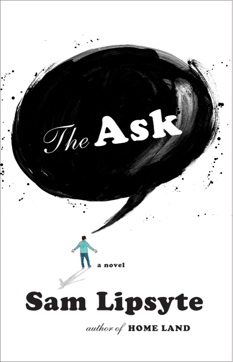
The Ask by Sam Lipsyte


The first-person narrator has just been fired, and rehired, by a university development office, where he had worked as a fund raised. "The Ask" is what they call their pitches to rich potential donors. Narrator gets reassigned to try to touch his old college buddy Purdy, who is incredibly rich. Meanwhile, narrator's marriage is crumbling. Narrator gets tasked by his rich college friend to shush college friend's illegitimate son, now a returned military veteran with two metal legs. The novel is all voice and no narrative. Sort of an American Martin Amis, but more of an obvious one-lining jokester.

All that said, what a voice:

Child care was like everything else. You got what you paid for, and your child paid for what you could not pay for.

You really had to hustle to recruit the right people to prop up your delusions, but the moment somebody broke ranks, or just broke for a protein shake, the whole deal teetered.

We were like the Frank family in their Dutch attic, but with email.

Why was I such a diseased fuck? It had to be society's fault. I loved people, all people, except for the ones with money and free time.

I dozed off worried I had truly unhooked myself from the apparatus of okay.

Never let them see you sweat, countless bastards tell us, just to see us sweat.

Sayuri's family moved back to Japan soon after, but from then on, whenever I inserted my penis in her hard little hand, I always made sure to insert the gray pixelated dot over it, like they did in Japanese porn. Honor is important to every culture.

"Hell, honey," said Claudia. "I murdered your father when you needed him most. I can take a few impotent barbs from my only son."

The man's hands looked ruined, though, rheumatoid, nicked and pinched by gruesome machinery. I'd done many odd jobs in my life, but hardly any heavy lifting. I stared at my own hands, soft, expressive things, gifted, even, like specially bred, lovingly shaved gerbils.

"But don't get me wrong. I'm all for capital punishment. I'm a huge death penalty guy. I like everything about it. And don't tell me how it's more expensive to the taxpayer than life sentences. Because if you ask me, we should pony up a little more. We should feel the cost of our ritual, revel in it. It was probably a drain on the Aztec economy to capture and drug all those people and carve out their living hearts, but are you going to tell me it wasn't worth it? Yes, sir, the death penalty is where it's at. Is there a chance innocent people die? I should fuckin hope so! Innocent people die constantly in this world. Why should things be better for those scumbags in lockdown?"

(on being an artist) "So, like I always say, it all comes down to how much you need to inflict yourself on the world. You're good enough. If you kiss the right ass, you could certainly make a career.

Wednesday, March 16, 2011

Devotion by Howard Norman

Norman clobbers the reader with his swans metaphor. Not much else happens.

Wednesday, March 09, 2011

Freedom by Jonathan Franzen


It’s thick and richly painted as far as it goes – but the sameness of each character’s “interior-ity” (is that a word?) deadened it for me, on the whole. Everything happened to everyone, and every thought occurred to every character, all the time. In the end, I was repelled (and truth be told, compelled) by how Franzen unspools this vast web of interconnected, richly detailed and remembered neuroses, and lets each character be driven by that, by neuroses and self-obsession. He’s so intelligent and wants to show it all over a wide canvas socially and politically – but I felt barely a ripple of narrative tension. A hundred pages from the end, I felt I could not care less about what was going to happen to the major players. Weirdly, I was most drawn to the characters of Joey and Connie. I hated Walter, though I believed him. Richard I didn’t believe, he seemed another side of Walter. Patty was hard for me to believe — Walter and Richard I could buy as having such verbose and self-scrutinizing inner lives – but not the alleged college jock. Also liked Patty's female college stalker, until she got addicted to heroin and sort of dribbled off into cliche. A way different sort of ménage a trois than To The End of the Land, in any event. Also, of course, energetically envious of the discipline and imagination required to get such a monster down on paper. Even if I seem to critically dislike it.

Friday, February 25, 2011

By Nightfall by Michael Cunningham


Awfully well-written AWFUL new novel (at least it was a quickie) by Michael Cunningham. The main character, Peter, a mildly successful Soho art dealer, has an inner voice that dominates the narration and is the kind of inner voice that one would like to punch in the face. His excruciating self-absorption and self-analysis drain all the life out of the book early. I guess people like Peter exist: I just don't want to know about them.

Enjoyed the observations on NYC and contemporary art, and even on aesthetics generally – but it failed on a flesh and blood level for me. Felt like it wanted to be a much longer book about Rebecca’s family: instead, much of her family got anecdotized (word?).

Peter and his wife Rebecca play host to Rebecca's much younger brother Mizzie (real name Ethan, but called The Mistake by Rebecca's family, since he's about 17 years younger than Rebecca), an aimless drifting twenty-something who has been messed up in drugs and now "wants to do something in the arts." The plot, what there is of it, revolves around Peter's obsession with Mizzie and failed attempt to seduce him.

Cunningham writes gorgeously about New York City, about the contemporary art scene, but fails, it seems to me, to write about Peter's previously heterosexual life with much conviction.
And for me it was just so gay from the get-go, I didn’t buy Peter as formerly straight, even partially straight. He was loathsome, I had not a spark of sympathy. There is an echo of Murdoch – certainly it shares her serious intentions – but it lacks her mordancy, her black-eyed morality, her treacherous plotting, and so some of her humor.

Friday, February 18, 2011

Skippy Dies by Paul Murray

Little Virgin Suicides by Jeffrey Eugenidies, little Edwin Mullhouse by Steven Millhauser.

Saturday, February 12, 2011

The Passage by Jusin Cronin


Februrary 12, 2010 b.v (from "The Book of Sean")
Have just finished The Passage by Jusin Cronin. No smokes are left in my life, no slims, no virals hang beneath bridges waiting to tear me asunder and drink my blood. I am at peace. Relieved even. My forearm swell with the effort of holding such a heavy book for so many long nights waiting for the lights to come back on. It was not the Book of Dave, oh no, not at all. Futuristic, every post-apocalyptic cliche and device possible.

Tuesday, January 18, 2011

Tinkers by Paul Harding


Mixed up narrative, the son dying present tense, crosscut with the father's tinker trip though the woods a half-century earlier. Long, blowing, circularly-breathed sentences, a la William Faulkner, via Cormac McCarthy.

Sunday, January 16, 2011

Maggot poems by Paul Muldoon

from the "Let's Hope He's Talking About Himself" Department...

One of the terrible facts about writing poetry is that actually one almost certainly disimproves as one continues…Most people who write poetry get worse. There are various other callings, one thinks, for example, of math. Most people involved with math, from what I understand, peak if they peak at all, earlier in their careers. And poetry, for whatever reason, it’s hard to write decent poetry in the first place and it’s very hard to continue to write it.

Here's an old one by Muldoon, which I must admit I like much better than anything in MAGGOT. It's long, but if that's its worst flaw I can forgive him.


The Old Country by Paul Muldoon


I
Where every town was a tidy town
and every garden a hanging garden.
A half could be had for half a crown.
Every major artery would harden

since every meal was a square meal.
Every clothesline showed a line of undies
yet no house was in dishabille.
Every Sunday took a month of Sundays

till everyone got it off by heart
every start was a bad start
since all conclusions were foregone.

Every wood had its twist of woodbine.
Every cliff its herd of fatalistic swine.
Every runnel was a Rubicon.

II
Every runnel was a Rubicon
and every annual a hardy annual
applying itself like linen to a lawn.
Every glove compartment held a manual

and a map of the roads, major and minor.
Every major road had major road works.
Every wishy-washy water diviner
had stood like a bulwark

against something worth standing against.
The smell of incense left us incensed
at the firing of the fort.

Every heron was a presager
of some disaster after which, we’d wager,
every resort was a last resort.
III

Every resort was a last resort
with a harbor that harbored an old grudge.
Every sale was a selling short.
There were those who simply wouldn’t budge

from the Dandy to the Rover.
That shouting was the shouting
but for which it was all over –
the weekend, I mean, we set off on an outing

with the weekday train timetable.
Every tower was a tower of Babel
that graced each corner of a bawn

where every lookout was a poor lookout.
Every rill had its unflashy trout.
Every runnel was a Rubicon.

IV

Every runnel was a Rubicon
where every ditch was a last ditch.
Every man was “a grand wee mon”
whose every pitch was another sales pitch

now every boat was a burned boat.
Every cap was a cap in hand.
Every coat a trailed coat.
Every band was a gallant band

across the broken bridge
and broken ridge after broken ridge
where you couldn’t beat a stick with a big stick.
.
Every straight road was a straight up speed trap.
Every decision was a snap.
Every cut was a cut to the quick.
V

Every cut was a cut to the quick
when the weasel’s twist met the weasel’s tooth
and Christ was somewhat impolitic
in branding as “weasels fighting in a hole”, forsooth,

the petrol-smugglers back on the old sod
when a vendor of red diesel
for whom every rod was a green rod
reminded one and all that the weasel

was nowhere to be found in that same quarter.
No mere mortar could withstand a ten-inch mortar.
Every hope was a forlorn hope.

So it was that the defenders
were taken in by their own blood-splendour.
Every slope was a slippery slope.

VI

Every slope was a slippery slope
where every shave was a very close shave
and money was money for old rope
where every grave was a watery grave

now every boat was, again, a burned boat.
Every dime-a-dozen rat a dime-a-dozen drowned rat
except for the whitrack, or stoat,
which the very Norsemen had down pat

as a weasel-word
though we know their speech was rather slurred.
Every time was time in the nick

just as every nick was a nick in time.
Every unsheathed sword was somehow sheathed in rime.
Every cut was a cut to the quick.
VII

Every cut was a cut to the quick
what with every feather a feather to ruffle.
Every whitrack was a whitterick.
Everyone was in a right kerfuffle

when from his hob some hobbledehoy
would venture the whitterick was a curlew.
Every wall was a wall of Troy
and every hunt a hunt in the purlieu

of a demesne so out of bounds
every hound might have been a hell-hound.
At every lane-end stood a milk-churn

whose every dent was a sign of indenture
to some pig-wormer or cattle-drencher.
Every point was a point of no return.


VIII

Every point was a point of no return
for those who had signed the Covenant in blood.
Every fern was a maidenhair fern
that gave every eye an eyeful of mud

ere it was plucked out and cast into the flame.
Every rowan was a mountain-ash.
Every swath-swathed mower made of his graft a game
and the hay-sash

went to the kemper best fit to kemp.
Every secretary was a temp
who could shift shape

like the river goddesses Banna and Boann.
Every two-a-penny maze was, at its heart, Minoan.
Every escape was a narrow escape.
IX

Every escape was a narrow escape
where every stroke was a broad stroke
of an ax on a pig-nape.
Every pig was a pig in a poke

though it scooted once through the Diamond
so unfalt… so unfalteringly.
The threshold of pain was outlimened
by the bar raised at high tea

now every scone was a drop scone.
Every ass had an ass’s jawbone
that might itself drop from grin to girn.

Every malt was a single malt.
Every pillar was a pillar of salt.
Every point was a point of no return.

X

Every point was a point of no return
where to make a mark was to overstep the mark.
Every brae had its own braw burn.
Every meadow had its meadowlark

that stood in for the laverock.
Those Norse had tried fjord after fjord
to find a tight wee place to dock.
When he made a scourge of small whin-cords,

Christ drove out the money-lenders
and all the other bitter-enders
when the thing to have done was take up the slack.

Whin was to furze as furze was to gorse.
Every hobbledehoy had his hobbledyhobbyhorse.
Every track was an inside track.
XI


Every track was an inside track
where every horse had the horse-sense
to know it was only a glorified hack.
Every graineen of gratitude was immense

and every platitude a familiar platitude.
Every kemple of hay was a kemple tossed in the air
by a haymaker in a hay-feud.
Every chair at the barn-dance a musical chair

given how every paltry poltroon
and his paltry dog could carry a tune
yet no one would carry the can

any more than Samson would carry the temple.
Every spinal column was a collapsing stemple.
Every flash was a flash in the pan.

XII


Every flash was a flash in the pan
and every border a herbaceous border
unless it happened to be an
herbaceous border as observed by the Recorder

or recorded by the Observer.
Every widdie stemmed from a willow-bole.
Every fervor was a religious fervor
by which we’d fly the godforsaken hole

into which we’d been flung by it.
Every pit was a bottomless pit
out of which every pig needed a piggyback.

Every cow had subsided in its subsidy.
Biddy winked at Paddy and Paddy winked at Biddy.
Every track was an inside track.

XIII


Every track was an inside track
and every job an inside job.
Every whitterick had been a whitrack
until, from his hobbledehob,

that hobbledehobbledehoy
had insisted the whitterick was a curlew.
But every boy was still “one of the boys”
and every girl “ye girl ye”

for whom every dance was a last dance
and every chance a last chance
and every let-down a terrible let-down

from the days when every list was a laundry list
in that old country where, we reminisced,
every town was a tidy town.
"Good-looking is the new well-read."

Saturday, January 01, 2011

To The end of the Land by David Grossman


Working up a review (download the .pdf!) of this novel for Tikkun, but need to mark it in time here. So far so good, two-thirds through it, a bit of a slog and not as earth-shattering as his 1989 work, See Under: Love, but Grossman builds and builds and builds in his novels, so I'm very interested in what happens at the end. Something better happen, that's for sure. Just sayin'.

Certainly reading Keith Richards' Life at the same time isn't helping me finish this. Imagine two more dissimilar books.

Life by Keith Richards


Don't know if he actually wrote a word of it, but the stories ring true, and the voice is the half-annoying, ribald, arrogant Keith Richards voice. A lot of the background social history for the fifties and sixties doesn't sound like him, and there's a lot of "it was my idea first, then Mick's" language around individual song compositions.

Here's a typical infuriating passage about his friendship with American saxophonist Bobby Keys:

'You have to ask Bobby Keys how big Texas is. It took me thirty years to convince him that Texas was actually just a huge landgrab by Sam Houston and Stephen Austin. "No fucking way. How dare you!" He's red in the face. So I laid a few books on him about what actually happened between Texas and Mexico, and six months later he says, "Your case seems to have some substance." I know the feeling, Bob. I used to believe that Scotland Yard was lily-white.'

Just not really believable, any of it. And the voice is ridiculous. Or this passage, allegedly from a notebook of song ideas and sketches that Richards kept during the mid-1960s:

JUKE JOINT... ALABAMA? GEORGIA?
Finally I'm in my element! An incredible band is wailing on a stage decorated with phosphorescent paint, the dance floor is moving as one, so does the sweat and the ribs cooking out back. The only thing that makes me stand out is that I'm white! Wonderfully, no one notices this aberration. I am accepted, I'm made to feel so warm. I am in heaven!

Still, a delish thing to read, impossible to put down.

Titus Andronicus, "The Monitor"

Monday, December 13, 2010

Versailles by Kathryn Davis


Liberty is a bitch who must be bedded on a mattress of corpses.

A wondous slender book about Marie Antoinette's career as the Queen of France and the scourge of the French Revolution.

Davis style -- of a compressed descriptive narrative in Marie Antoinette's voice, an omnisciene "brochure voice" describing the structural achievement of the palace, and the natural spectacle of the gardens, as well as little dramatic "playlets" featuring other characters from the period before and during the Revolution -- has an awesome cumulative effect, that took me by emotional surprise at the end of the novel. I cared for Marie Antoinette, cared for her one little voice piping up from the crush of a humanity in revolt.

Tuesday, December 07, 2010

Cock and Bull by Will Self


Carol had a good head for alcohol - in fact, she had a spy's head for alcohol; for as she drank, her washed blue eyes grew flatter and beadier, giving an accurate, if tarnished reflection of some pebbledashed saturnalia. That's what one felt, watching her: that as she drank, she was somehow accumulating evidence against those who got drunk.

A little devil sat on Alan's left shoulder, a little angel on his right. On the right-hand shoulder of the little devil sat a littler angel; and on the left-hand shoulder a littler devil. It was the same for the first angel, and so on, and so on. This was the reductio ad infinitum of Alan's moral sense: a great Renaissance canvas depicting diminishing tiers of cherubim and seraphim, imps, satyrs and familiars. All towering up into an impossible void.

In this world where all are mad and none are bad, we all know that the finger points backwards.

Wednesday, December 01, 2010

Lauren Bacall singing "Sob Sister" in The Big Sleep

Click here to watch the clip on YouTube.

What a film! Wonderfully sharp writing (Faulkner kicked in on the screenplay), Bogart and Bacall hitting all the high notes. Interesting commentary with dvd on how the film was held a year and a half for the war to end so the studio could rush all its war pictures out before it ended. Also, some of Bacall's scenes were reshot, and extra ones with her added, on the advice of her agent, who was trying to help her recover from her bad reviews in The Confidential Agent, her previous film. And they took her veil off her, which is aesthetically pleasing!

Monday, November 22, 2010

See Under: Love by David Grossman

A nuanced, high-octane-language experiment in memory, imagination, language and longing, wise and cruel and intelligent and relentless. Long and grueling, too, imitative of the ordeal of the Holocaust experience itself, which at least ended temporally, and the eternal struggle for Jews and others to try to understand the unimaginable.

The first section, Momik, is from a young boy's point of view, who will later go on in life to try to write about the Holocaust. Living in a small town in Israel, with his parents, addled Holocaust survivors whose fears are endless, Momik creates a collection of animals in his basement in order to lure into the open "The Nazi Beast" which his parents and family constantly and ominously refer to, and which he thinks is a monstrous animal. At one point he leads a collection of the town most pitiful and lost souls, also Holocaust survivors, down into the cellar to use them to bait the Nazi Beast:

... Show it, show it, go on, be Jews and show it, and he crouched down with his hands on his knees as if he were coaching the players on the soccer field and inwardly shouted, Now, now, go on, be wizards and prophets and witches and let's give it one more battle, one last fight, be so Jewish it won't know what to do with itself, and even if the Beast was never here before, now it's got to come out...

The second section, Bruno, is from an adult Momik's viewpoint as he researches the writings of Bruno Schulz, a Jewish writer shot by an SS man during WWII.

The sea smiles. It slides a wave Bruno's way, an experienced croupier dealing out a lucky card to a regular customer.


Now I write with a steady pen: Bruno Schulz. Ingenious architect of a singular linguistic experience, the magic of which lies in fertility, a plethora almost rotting with verbal juices. Bruno who knows how to say everything in ten different ways, each as accurate as the compass needle. A Don Juan of language, conquering with a mad, almost immoral passion, audacious explorer of linguistic geography ... Could it be that you, Bruno, reached the limits of this world, and ran around like a madman on the beach when you couldn't find a suitable verbal vessel to sail you into the misty horizon?

The third section, Wasserman, concerns Momik's grandfather and his odd relationship with the commandant of his concentration camp, Neigel. Wasserman suffers a curious ironic condition in the camp: he cannot be killed. And when Neigel learns that Wasserman is author of a series of childhood stories, The Children of the Heart, which Neigel loved, he makes Wasserman live in his attic and begin a new series of adventures for The Children, picking up fifty years later in their lives. He calls Wasserman Scheherezade, and gives him the obverse fate: after each nightly story Wasserman tells him, Neigel will attempt to murder Wasserman again, which is all Wasserman wants, having seen his wife perish in the camp, and his daughter shot to death by Neigel right after they got off the transport train.

The fourth section, The Complete Encyclopedia of Kazik's Life, is an alphabetical concordance of Hebrew terms, in which is related the autobiography of Kazik, a mystical child engendered by the reunited Children of the Heart. Kazik is born, lives and dies within a single day, a la Max Tivoli, the Fitzgerald story, and the Curious Case of Benjamin Button.

In his essay on literature, "Books That Have Read Me," Grossman remembers reading books as a child in a poetic and archaic Hebrew that was very far from the everyday language he knew, and it was a pleasure for him, the unknown words, the gaps, "inferring one thing from another." He transfers that sensation to us in this novel, which is laced with Hebrew words (some defined in a glossary at the end of the book, but many more not).

Monday, November 15, 2010

Room by Emma Donoghue


Shortlisted for the 2010 Booker Prize, Room has a glorious initial premise: it's a first-person narration by a five-year-old boy (Jack) who's held hostage in a tiny backyard shed by a brutal man (Old Nick) who kidnapped Jack's mother (Ma) when she was nineteen and raped her repeatedly. Jack has spent his entire life in the shed, with only a skylight window. And the novel opens on Jack's fifth birthday, where his mother has decided Jack's finally just barely old enough to help her in a desperate attempt to escape.

Whew. Writes itself, right? Jack's voice is marvelous throughout. It reminded me of Roddy Doyle's Paddy Clarke Ha ha. And for some reason a little of Flowers for Algernon.

The book is in two parts: Inside and Outside. Though the voice of Jack, and the character of his Ma are consistently strong and engaging, the plot suffers once they get Out. We miss Old Nick's malevolent presence just off screen. Of course, Jack must learn the entire world, which is what makes the second half interesting. He knew of only two other people in existence. He had never been outside, seen sky, walk up a step.

Saturday, November 06, 2010

A Visit from the Goon Squad by Jennifer Egan

Not really about music, although ostensibly about a handful of people who first meet in 1980 during the rise of the punk (well, post-punk, really) era. First Egan novel I've read, and I'm impressed. A book about survivorship and bad choices and persistence and emotional pain, among other things. Egan effortlessly describes the lower East Side of Manhattan, Naples, the African veldt, suburban New York suburbs. It reminded me (in a way) of David Mitchell's Cloud Atlas, in that the chapters move radically in voice and time and emphasis one to the next, in the manner of wonderful, sadistic meal, where you are left longing for the last taste in your mouth, even as a new and even better taste replaces it. I suffered from chapter-nostalgia constantly.

Friday, October 29, 2010

Memento Mori by Muriel Spark

Muriel Spark's "old people" novel from 1959 has dozens of major characters, and we jump in and out of every one of their consciousnesses, at one point or another.

Most of the charcters are elderly, living in retirement homes or in their homes, but in their seventies and eighties. Spark's touch with them is gentle: it is not the first thing you find out about them, that they are aged. Instead, you got an insight from their perspective, a perception that does not seem to come from a feeble or senile mind.

The central plot element of the novel is an anoymous caller who telephones each of the old people at one point or another to tell them, "Remember that you must die." The police are called in, and various theories about the identity of the caller are propounded. But his voice, accent, age and inflection differ for each person; he seems to know where each person has recently been, and so the wise (and elderly) former detective on the case, by novel's end, is forced to surmise that the caller is Death himself.

Wednesday, October 20, 2010

The Sailor Who Fell From Grace With The Sea by Yukio Mishima


A powerful, beautiful, brutal book. As if reading it for the first time, I was stunned by it. (I went through, or thought I went through, an intense Mishima obsession as an undergraduate back during the Grover Cleveland administration, but can't be sure of anything from that period, it seems.) The point of view shifts throughout the book between the three main characters, the sailor Ryuji, the widow Fusako and her 13 year old son Noboru, but the reins are held by a cool and fatalistic omniscient narrator. The sailor and the widow fall in love during the sailor's leave, one summer, and the son watches their lovemaking from inside his dresser cabiner in his room, through a crevice in a wallboard.

Mishimi's language is at once strikingly metaphorical and disturbingly concrete. The sailor's memories of the sea, transmiited to Noboru, take on a deadly chant-like rhythm, as the sailor realizes he will put the sea behind him and marry the widow, giving up the highs and lows of the dramatic, and sometimes monotonous, ocean, for the peace and living-death of a comfortable marriage. (He was dealing here with no ocean squall but the gentle breeze that blows ceaselessly over the land.)

For the boy, this is ultimately a betrayal of the canon of his gang of friends, led by the psychotic "Chief," who instructs the rest of the gang in a grisly system of nihilism and existenialism that renounces almost everything in the world as worthless. "Except for the ocean, and a couple other things," the chief says at one point. "Ships," Noboru adds hopefully. "Maybe ships," the chief replies. The widow moves between the two men, tending to her clothing store, hoping to replace her dead husband and thus further "care" for her son, overjoyed to end her five year loneliness as a widow.

Friday, October 15, 2010

You Remind Me of Me by Dan Chaon

By the author of Await Your Reply. This is his first book and a very good one, if a bit long. It's an examination of two young men, separated at birth: the older brother given up for adoption by the troubled mother, who then has the second child and vows to keep him and make up for her first grievous loss by hanging on to him. In many ways, it's an inversion of the standard view that the child given up for adoption is the loser, for in this case, though the adopted son has struggles of his own, he is a joyful case compared with the son who is kept, who watches his mother disintegrate via substance abuse and severe depression, and eventually takes her own life. The younger son strikes out to find his older brother, a small-time marijuana dealer who has done time, but who marries (if badly) and has a son whom he worships.

Saturday, September 25, 2010

If... (1968, Lindsey Anderson, director)


A strange 1968 film starring Malcolm McDowell as a junior at a deeply traditional English public school. A grower, for sure, starts out sleepily, moves through a three-act, dramatic construction that grows more surreal and violent.

McDowell is exceptionally cast.

Tuesday, September 21, 2010

An Evening of Long Goodbyes by Paul Murray, The Long Goodbye by Raymond Chandler


"No, no..." I hastened to set her at ease. "I've heard far worse stories. For instance, this one chap I know, Pongo McGurks, his family had a butler, name of Sanderson - had him for years, used to swear by him, best butler they'd ever hard, et cetera. Then they come back early from a weekend away to find him in Pongo's mother's wedding dress, about to have the toaster marry him to the cuckoo clock."

"Oh." She seemed not quite to know what to make of this. "And this happens often?"

"No, I suppose it's pretty rare," I conceded. "I mean, it's rare that you have a butler who's a perfect size ten." This wasn't coming out right at all.

What a long slog of a heavily-favored book by a young Irish writer whose new novel, Skippy Dies, was what I was actually looking for. But it's too new, the library didn't have it, so I got this one, and hope I didn't poison my own well-spring of enthusiasm for this guy, because THE EVENING just didn't cut it, took forever, not in the good way of the Stieg Larsson series, for instance, or the recent The Lonely Polygamist, which I still haven't gotten around to talking about. Just forever like, this is boring, it does sound just enough like P.G. Wodehouse at times then I guess I'm going to hang around and finish it but when will it GET GOOD?


Putting these two books together out of sheer impishness, a shared phrase in the titles. Two more different books could probably not exist.

Money. Those are the first five letters of his alphabet.

Saturday, September 04, 2010

Unposed, Photographs by Craig Semetko


PRE-ORDER IT MOFO


Song of a Camera
a poem by Thom Gunn
for Robert Mapplethorpe
I cut the sentence
out of a life
out of the story
with my little knife

Each bit I cut
shows one alone
dressed or undressed
young full-grown

Look at the bits
He eats he cries
Look at the way
he stands he dies

so that another
seeing the bits
and seeing how
none of them fits

wants to add
adverbs to verbs
A bit on his own
simply disturbs

Wants to say
as well as see
wants to say
valiantly

interpreting
some look in the eyes
a triumph mixed up
with surprise

I cut this sentence
look again
for cowardice
boredom pain

Find what you seek
find what you fear
and be assured
nothing is here

I am the eye
that cut the life
you stand you lie
I am the knife

Tuesday, August 31, 2010

Molloy/Malone Dies/The Unnamable by Samuel Beckett


Molloy

It's so nice to know where you're going, in the early stages. It almost rids you of the wish to go there.

I was out of sorts. They are deep, my sorts, a deep ditch, and I am not often out of them.

Not to want to say, not to know what you want to say, not to be able to say what you think you want to say, and never to stop saying, or hardly ever, that is the thing to keep in mind, even in the heat of composition.

And in winter, under my greatcoat, I wrapped myself in swathes of newspaper, and did not shed them until the earth awoke, for good, in April. The Times Literary Supplement was admirably adapted to this purpose, of a neverfailing toughness and impermeability. Even farts made no impression on it. I can't help it, gas escapes from my fundament on the least pretext, it's hard not to mention it now and then, however great my distaste. One day I counted them. Three hundred and fifteen farts in nineteen hours, or an average of over sixteen farts an hour. After all it's not excessive. Four farts every fifteen minutes. It's nothing. Not even one fart every four minutes. It's unbelievable. Damn it, I hardly fart at all, I should never have mentioned it.

There I am then back in the saddle, in my numbed heart a prick of misgiving, like one dying of cancer obliged to consult his dentist.

All roads were right for me, a wrong road was an event, for me.

Precautions are like resolutions, to be taken with precaution.

For I always say either too much or too little, which is a terrible thing for a man with a passion for truth like mine.


Friday, August 27, 2010

The Bachelors by Muriel Spark


"I got a young woman into trouble at the age of eighteen," Walter said. "Daughter of one of our footmen. He was an Irish fellow. The butler caught him reading Nietzsche in the pantry. To the detriment of the silver. Of course there was no question of my marrying his daughter. The family made a settlement, and I went abroad to paint. My hair turned white at the age of nineteen."

He resolved to go to confession, less to rid himself of the past night's thoughts - since his priest made a distinction between sins of thought and these convulsive dances and dialogues of the mind - than to receive, in absolution, a friendly gesture of recognition from the maker of heaven and earth, vigilant manipulator of the falling sickness.

It is all demonology and to do with creatures of the air, and there are others beside ourselves, he thought, who lie in their beds like happy countries that have no history.

Tuesday, August 24, 2010

The Quickening Maze by Alan Foulds

This unusual novel imagines the confluence of two great 19th century poets, John Clare and Alfred Tennyson, after Tennyson's brother Septimus is confined to the same mental asylum that Clare has been committed to. They barely meet, but their associates and friends intermingle, and the associations lend a mystical atmosphere to what is already a heady environment for poetry. Clare, an extreme alcoholic, escapes several times from the ground to take up with a colony of gypsies staying in the surrounding forest, exiled as they had been from English common land by draconian property laws, the infamous "enclosure" enforcement that reduced the circumstances of the poor working class even more.

The asylum director falls into a friendship with Tennyson and borrows money from him to fund an invention, a device for mass producing craft wood furniture, which fails utterly. The director's daughter falls in love with Tennyson.

The Fear Of Flowers

The nodding oxeye bends before the wind,
The woodbine quakes lest boys their flowers should find,
And prickly dogrose spite of its array
Can't dare the blossom-seeking hand away,
While thistles wear their heavy knobs of bloom
Proud as a warhorse wears its haughty plume,
And by the roadside danger's self defy;
On commons where pined sheep and oxen lie
In ruddy pomp and ever thronging mood
It stands and spreads like danger in a wood,
And in the village street where meanest weeds
Can't stand untouched to fill their husks with seeds,
The haughty thistle oer all danger towers,
In every place the very wasp of flowers.

John Clare

Wednesday, August 04, 2010

Been Down So Long It Looks Like Up To Me by Richard Farina


Let me tell you, man, you can't move in this country without catching your heel in a hangup. Mousetails in your root beer, grubs in your Hershey bar, always some kind of worm in the image, muching away.

A dazzling, fizzling, appalling, and tragic book. Farina, a classmate and sometimes-pal of Thomas Pynchon's (Gravity's Rainbow is dedicated to Farina) at Cornell, also enjoyed a career as a folk-rocker, married to Joan Baez's sister Mimi, and recorded several seminal folk-rock albums with her, including the stunning Celebrations for a Grey Day. (In David Hajdu's provocative cultural memoir Positively 4th Street, Farina even gets credited with creating the knowing, enigmatic, American artiste-as-provocateur persona that no less than Bob Dylan steals and makes his own.)

In 1966, he slipped out of a publication party for Been Down So Long to ride with a friend on his new motorcycle, and died off a hairpin turn in the Carmel hills.

Haven't read it in years, but remember parts so clearly. The prose is heavily written and re-written, there is a cannabis smell to it, too worked over, an emphasis on sensation and re-representation, rather than versimilitude. Too many words. Too many descriptions. Many bad trips and sensations of bad things coming. But there is marvelous stuff, too: Gnossos dancing on the ice packs covering the local river at the beginning of the spring thaw, urging Spring on, some incredible character thumbnails, his red-gummed Indian neighbors forever drunk on grenadine and gin, slipping prophecies under his door, the lists, the lists! Wish I had the nerve (or the typing skill) to recreate them here.

It received bad reviews when it appeared, but critical opinion over the years has changed as the novel's place in the canon of 60s literature has grown more assured.

The plot is ridiculous and campus-bound, but enhanced by intercut scenes of what Gnossos was doing before returning to campus, when he roamed the West and witnessed a nucelar test detonation in the desert, stoned on mescaline, marijuana (his beloved "panegyric") and drunk on boozed (his beloved "lush.").

The problem is motivation: why is Gnossos so quest- and darkness-obsessed? I hate to sound like a wrtng instrctr, but... back story?

The lists are dense and telling: American plastic culture at its best and most dizzying. I tell you, I think it's a better book than Pynchon's initial sally The Crying of Lot 49.

It's pre-hippie, pre Summer of Love. The only music is some jazz (Brubeck is dissed, Miles is adored), some Mose Allison, some soul references, some Indian raga music.

The president is Eisenhower. The year is 1958. The setting is a college campus in upstate New York positively pulled with Greek-sounded streets and buildings. The narrator, Gnossos Papadopoulis, is clearly Greek. The scene on campus is seething: the administration is cracking down on sex, and the students are rising up against curfew hours and restrictions.

There is (without doubt) an immaturity to the book, a misogyny: Gnossoes is self-conscious to the point of paralysis, Hamletian. But Farina was all of 29 when he finished it. If anything, what doomed it at the time is that it was a 1969 book published in 1966, way ahead of its time.

Farina had an Irish father and a Cuban mother, allegedly fought in Cuba with Castro.

Friday, July 30, 2010

Death, "For the Whole World to See"


Sheesh. Great lost Detroit black punk band, who recorded seven singles in and around 1974 with the help of Funkadelic producer Don Davis, who must not have done much but turn the recorder on and let it bleed. Certainly some MC5 ringing in their ears, little Stooges, not much metal in the fast stuff but some in the bluesy slower stuff: the tremendous thing about these songs is not who they sound LIKE, but who FOLLOWED them and sounded like them. Particularly the Bad Brains, who either listened to this in their sleep or are these guys children. The stuttering drums, the crushing guitar riffs, the simple-as-brain-damage refrains, the dum-dum-bullet-stupid bass: I'm such a troglodyte at heart! "Keep on Knocking" is the standout, but "Rock n Roll Victim" is the Bad Brains-ish one for sure. Love the songs, love the narrative (brought to me, pathetically enough, by a New Yorker article about them this week. But it made me crank some Bad Brains for the wife, and we thought we were hearing some lost Kiss or some neanderthal Van Halen for sure. For thor's sake buy it (not that I did) and give the guys some money after all these years.

Thursday, July 29, 2010

The Suspect, L. R. Wright


A quietly satisfying mystery novel, remniscent of Simenon: one finds out WhoDunIt in the first pages, but the book unfolds as as WhyDunIt, a masterful character study set in a small town in British Columbia featuring a Royal Mountie detective, a librarian, and two old men, principally, but other characters are quickly and deftly sketched.

There is very little violence, except implied, or recalled: the murder of one very old man by another very old man. The reason for the crime comes out slowly, through flashbacks. The tremendous natural landscape of BC plays a role too, as a destructive force each character struggles against, as a creative force each character struggles to find a nourishing spot within.

Sleep while I Sing takes place after The Suspect: the detective and the librarian are repeating characters, and their relationship, romantic, emotional and intellectual, is important in both books.

Saturday, July 24, 2010

Palladio by Jonathan Dee


I read Palladio with excitement and curiosity, a novel about the advertising business (and other things). My good friend and fiction reviewer without peer Donna Rifkind had recommended Dee's new novel, The Privileges, but I had to wait for my hold at the public library, and snapped up Palladio in the meantime. Dee is a morbidly interesting writer -- that is, I had no idea I was so interested in the world of advertising, the contemporary world of advertising, as well as a thumbnail history of advertising in America in the past fifty years, until Dee began telling me a story about a young man and an older man in that business. Oh yeah, there's a woman too, but it's mostly about advertising. Dee will be compared (by others certainly, and now by me) to Tom Wolfe, since there is a "masters of the universe" sort of a feel to his protagonists (even more so The Privileges) and if I had ever been able to finish a single Wolf novel, I might even make the comparison ring true. But I haven't. Still recommend this book, though: Dee has a marvelous gift.

So I get the new one finally and I'm in a tizzy of anticipation, glancing at it on my nightstand, dutifully (and happily, if in a hard-working sort of way) finishing David Mitchell's stunning Cloud Atlas before I dig in. And The Privileges is a good read, compelling, and Dee once again makes several uber-rich lives somewhat transparent to me and interesting, but on the whole the new one was a disappointment, second half of the book never really delivers on the thesis grandly contstructed in the first half -- that is, a successful couple, I mean so successful that in the second half of the novels pedestrian details like actual numbers of dollars and how many millions have vanished completely , a successful couple (and their couple of somewhat less successful, if gorgeous, children) will have to eventually pay the piper in some fashion for all their success. They don't pay. The wife's father dies, the husband blows out his knee during one of his fanatical workouts, they must stand by their daughter after she is in a bad car wreck where some people apparently die, after partying for several days and nights with her at one of her family's many luxury homes, and the son is held hostage by an "outsider artist" he is considering promoting. (I'm not making that outsider artist bit up, though it sounds like I am.

Monday, July 12, 2010

Cloud Atlas by David Mitchell


Cloud Atlas is a tour de force. A lengthy "novel" consisting of six novellas that move chronologically from the early 19th century to the distant post-apocalyptic future in the first half of the book, then reverse and run backwards in time in the second half (from p.a. future to 19th century, so we end where we began), and which six novellas are linked with what at first seem to be casual coincidences (the diary chronicling a sea voyage in the first novella becomes a tattered rare book that a young composer in the 1930s finds and reads in the second novella, a piece by the young composer is heard in the third novella), it as ambitious and experimental and daring as it is compellingly and closely written in each of the six wildly-different narratives.

The Hidden Fortress, Akira Kurosawa

My son and I saw THE HIDDEN FORTRESS at AFI Silver yesterday afternoon, what a masterpiece! The 21-year old Misa Uehara as the Princess was particuarly astounding, more than holding her own next to the redoubtable Toshiro Mifune as the General, and Minoru Chiaki and Kamatari Fujiwara as the two peasants reluctantly accompanying the Princess across ... See Moreenemy territory. They are equal parts Rosenkrantz and Guildenstern, the grave-diggers from Hamlet, and reputedly George Lucas's models for C3PO and R2D2 in Star Wars. A stunner.

Saturday, July 03, 2010

Love in the Ruins, Walker Percy (1971)


Forty-five. It is strange how little one changes. The psychologists are all wrong about puberty. Puberty changes nothing. This morning I woke with exactly the same cosmic-sexual-religious longing I woke up with when I was ten years old. Nothing changes but accidentals: your toes rotate, showing more skin. Every molecule in your body has been replaced but you are exactly the same... The scientists are wrong: man is not his own juices but a vortex, a traveling suck in his juices.

Saturday, June 19, 2010

Blame by Michelle Huneven

Slaughterhouse Five by Kurt Vonnegut, Jr.

So... no review yet, Seana? OK i get it -- this brilliant book speaks for itself, it's the story i most wish i'd written by the writer i most wish i were. first experience of it was a vinyl LP (yes i'm old) recorded book from the library -- first 2 chapters, read by kvjr. himself. (the other 2formative lps were spoken chapters of walden and george carlin's am/fm.) read the book soon thereafter and over & over since, and thanks to it i am perpetually (like billy pilgrim) unstuck in time, and convinced (like the tralfamordians) that life's just a bowl of cherries, i.e. a collection of vividly tasted moments, occurring simultaneously & ever accessible in the 'here and now.') point is... thank you, kvjr, and thanks sean for bringing him to mind.

I quote (without permission, thus far) a comment by my old and deep friend Steve Hayes, a mentor, nay, magister!, whom I am lucky enough to have held on to all these years, a comment spurning me to complete this hapless posting of a cover image of my beloved Schlacthaus Funf, which Steve and I probably read for the first time within a year or two of each of at Gonzaga High School. Yes, a terribly special book, a memorable book which I too have re-read over the years without any real need, since whole paragraphs seem to spring to memory whenever I wish, untrue about almost every other novel I have read in my life, a life which will be most notable for Number Of Novels Consumed, if nothing else.

First and foremost, the prose style is beautifully simple and profound, one reason it was such a controversial smash when it was published (1969), as it finds avid fallow soil in the adolescent mind. The simple declarative (but no less allusive) sentences are still rigidly effective after so many years. After a fervent teen following in the 1970s, it has been widely banned and contested as suitable reading material for high school students, ever since, the way they bury a book in Amurica.

The number of Germans burned to a crisp in the fire-bombing of Dresden may very well be closer to 25,000 than to the 132,000 that Vonnegut claims, and this may be of import to the burnt-bean-counters of miliary logistics, but Vonnegut's moral and aesthetic claim that this ruined the subsequent imaginary life of his poor hero Billy Pilgrim is without challenge, vide PTSD ruining the lives of hundreds of war veterans in the past 20 years who witnessed far less numerical slaughter in Iraq and Afghanistan.

Second and foremore, it is an anti-war novel about a war -- WWII -- still roundly acclaimed as "the last good war." And a good 'un it undoubtedly is in the prism of history, the systematic defeat of a global menace. But Vonnegut sticks to his man's eyes -- Billy Pilgrim's -- a fragile set of eyes to begin with, that crumple in the very first instance of hands-on warfare. And Vonnegut is more concerned with the larger lens of the years that follow Billy Pilgrim's brief, utterly naive service in the very last months of the Second World War, as Billy returns to America and collapses slowly and inutterably over the 25 years that follow.

For me, at least now when the assurance of science fiction printed literature has abided a great deal (who cares now that you can buy the game and BE THE SHIT, right?), the science fiction sections of the novel are not as moving as they once were, but they certainly provide a counterpoint, and it's important to remember the vital emergence of science fiction in American literature in the 1950s and 1960s (Slaughterhouse Five lost out to no less than Ursula LeGuin's The Left Hand of Darkness (another shatteringly good "sci fi" title) in 1970 for both the Hugo and the Nebula Award, no small shit for us pointy-headed sci fi fans at the time).

It seems to do that rare thing in penetrating a harsh shared space between realistic fiction and "speculative fiction," where the jump to speculative is a result of something real, is a psychological adjustment, and makes more sense than just the pure fantasy realm.

There, Steve: it's what I got, at the moment. But I hear you, and adore it much the same as you did, and do.

Also snuck in the surprisingly good 1973 film of same right after I read this -- Ame liked it too -- it had this gooey early 1970s film technique to it that was jes right.

The Lonely Polygamist by Brady Udall

Friday, May 21, 2010

Lit by Mary Karr and The Seven Storey Mountain by Thomas Merton


Tradition means giving votes to the most obscure of all classes, our ancestors. It is the democracy of the dead. Tradition refuses to submit to that arrogant oligarchy who merely happen to be walking around. - GK Chesterton, Orthodoxy, 1908

I'm going to try to combine an appreciation of books side by side. It had occurred to me already, late in Karr's memoir, that I might find some friction and frisson by writing about both while balanced on one beam, before the late-breaking development that she falls for Merton and converts to Catholicism herself.

This book didn't dazzle me like Liar's Club did (now due for a revisit, seventeen years after I first read it), and I totally missed Cherry. But it grew on me. Almost tossed it aside halfway through -- I don't love non-fiction, particularly memoirs -- there's this pathetic, completely naive reader in me (the larger part, for sure) who listens to voices in narrative and believes they are real, despite the genre -- and I had niggling concerns throughout this book that I actually might hate the speaker and that because she was in fact a real person, this bothered me to no end.


How embarassing that I'd never read this earlier. A gorgeous, profound meditation on living and meaning.

The devil is no fool. He can get people feeling about heaven the way they ought to feel about hell. He can make them fear the means of grace the way they do not fear sin. And he does so, not by light but by obscurity, not by realities but by shadows, not by clarity and substance bu by dreams and the creatures of psychosis. And men are so poor in intelletct that a few cold chills down their spine will be enough to keep them from ever finding out the truth about anything. (p. 29-30, Harcourt Brice, 1998, 50th Anniversary Edition.)

The one who does most to avoid suffering is, in the end, the one who suffers most; and his suffering comes to him from things so little and trivial that one can say that it is no longer objective at all. It is his own existence, his own being that, that is at once the subject and the source of his pain, and his very existence and consciousness is his greatest torture. This is another of the great perversions by which the devil uses our philosophies to turn our whole nature inside out, and eviscerate all our capacities for good, turning them against ourselves. (p. 91)

Featured Post

Buy my books.

Buy the books on Amazon, and watch videos of some readings.   Please.