
Friday, June 03, 2011


Thursday, May 19, 2011

Driving on the Rim by Thomas McGuane

Little too wooly for me. Starts out well, and lots of funny stuff along the way, but halfway through he starts saying too much, which is just not like McGuane at his best.
Wednesday, May 04, 2011

Wednesday, April 27, 2011
Just Kids by Patti Smith

Such charm at the start of this rich memoir of Patti Smith's great friendship with Robert Mapplethorpe, form when they were nobodies at all to when they were the avant of the avant garde of New York City, but it weakens haflway through as Patti Smith's pretentions take over.
She knew (and to believe her, almost created) Mapplethorpe, Sam Shepard, Janis Joplin, and a host of other key 1960s counterculture heroes.
Yet who is she? Where are the poems? Her references to herself are jump-cut, as if she learned everything the moment someone else eventually famous affirmed it for her.
Sunday, April 24, 2011
His Illegal Self by Peter Carey
 Not worth the effort. The prose is elusive, allusive, complex, but the story of an abandoned child of famous 1960s radicals, and the hippy woman who pretends she is his mother, does not fit with the prose. I threw it aside. I didn't have time to struggle with it anymore. Why does one give up one book in particular, and yet put up with the others that might be lesser literary achievements?
Saturday, April 16, 2011
Penelope by Enda Walsh

Wow, what a thing this play is! A 90 minute crucible of poetry, vaudeville, little magic and mime, Herb Alber tunes, 9000 jokes and four men in speedos wooing Odysseus' wife. No intermission. Couldn't breathe until I got home.
Just finished reading it, a whole different, lesser experience. Still extraordinary though.
The Keep by Jennifer Egan

Gothic thriller? Prison memoir? Coming of age memori? Revenge fable? Dunno.
Wednesday, April 06, 2011

Music for Torching by A. M. Homes

Is this what passed for shocking in late 90s suburban fiction? Lame. Sort of a swingers book, married couple grown bored with each other, husband experiments (lightly) with cross dressing, s&m, continues his numerous affairs, wife experiments with lesbianism. both drink alot and ignore their children. No biggie. Very boring.

Sunday, April 03, 2011
The Unnamed by Joshua Ferris
 Very moved by this book. Ashamed that I never finished his Then We Came to the End, will now go back and read it.
This is the story of a partner in a Manhattan law firm who is stricken with a mysterious "wandering" syndrome, where he must pick up and walk and keep walking. Countless mental and physical health experts are confounded by it, swamis can do nothing. It is also the story of his marriage and how it persists somehow through the days, months and years of his condition.
In the second half of the book, where he is literally on the road for years, he receives messages and emails and see his daughter marry, have children, his wife see another man, go to the South of France with him on vacation. But time by this point is moving as if off screen.
The point is He walks. Also a second voice for the man crops up in the second half, the weaker "physical" self that demands food and sleep. The stronger "spirit" half controls him though, and the man walks into extreme physical duress, loses fingers and toes to frostbite, develops a host of serious physical illnesses and keeps walk.
Very beautfiul prose throughout.
I respected you more when you were indifferent to God. You were beset by matters of urgency in your life that took precedence over the lofty speculation of divinity students and men in pews on Sundays. You didn't have the time. You didn't make it a priority. You formed your notions on the fly, in flashes of grim insight, in brief feelings of certainty that consumed you entirely and then quickly faded into the background. When you die, you thought, you die. Why linger on that unpalatable truth? And the alternative, the alternative was a sham. You hated the institutions and the corruptions and the hypocrisies and the evils. You thought it was all a racket designed by the mighty to fleece the weak and keep them in check.... You stood outside of the wind and the rain. Your insights and arguments came to you in prosperity. Death was far off. You could afford to be leisurely. A drink was better than a thought. A meal was better than a conviction. Your family and your work was more meaningful to you than the ministrations of a hundred gods. That is, until you caved.
To be lost in the writing was to be absorbed, and to be absorbed was to lose awareness of everything - the shitty view and the third-class furniture, but also, and here was the paradox, the contentment. To be lost in the writing was to be happy, but it reguired giving up any awareness of that happiness, of any awareness whatsoever, and so he was blissfully unaware...
Tuesday, March 29, 2011
Mr. Peanut by Adam Ross

Very interesting, at times sublime, novel. Three novels in one, at least. The first, framing story is about the down-turn of the marriage of a very successful video game designer and a counselor for disturbed children, a woman who has lost over 150 pounds finally after years of dieting. Her husband, though, over the 13 years of their marriage, has found himself fantasizing often about her death. And that's how the novel opens, with the husband accused of killing her by forcing two fistfuls of peanuts down her throat, which she is highly allergic to, and which he knows will kill her. The husband is also writing a novel, which may or may not be the book we are reading. He's also been in touch with a private eye/hired killer named Mobius, who may or may not have decided to murder the wife on his own
Enter novels number two and three, about the two detectives who question the husband. The first detective is suffering marital woes of his own: his wife has refused to leave her bedroom for five months. The second detective is none other than Sam Shepard, the midwest doctor accused of murdering his wife, who was exonerated and released from prison after serving ten years, a case widely believed to be the basis of the TV series The Fugitive.
The lengthy novella about Sam Shepard's marriage and affairs might be the best thing about the book, although all three stories have their power.
It's a bit of a puzzle piece, sorting out what is real, what is imagined, what is the first husband's imagination, what's his novel, and what's the real narrative we're reading.
In the end, it's a dark, compulsive, often beautiful examination of marriage almost exclusively through several husbands' eyes. Men don't come out smelling too nice by the end. Women aren't much better.
Friday, March 25, 2011
Solar by Ian McEwan
 A nice corrective to Franzen's Freedom, in the category of "climate-change fiction." McEwan, skillful as always, has no trouble at all navigating the worlds of post-quantum physics, 21st climatology, dance apparel shops in contemporary London, Arctic Circle snowmobile tours. His anti-hero, corpulent, adulterous, selfish physicist Michael Beard, is a Nobel-prize-winning comic figure who steals ideas, cheats on dozens of women (including five wives), rigs murder scenes and nearly freezes his penis off on said snowmobile tour.
 Recommended!
Tuesday, March 22, 2011
The Ask by Sam Lipsyte
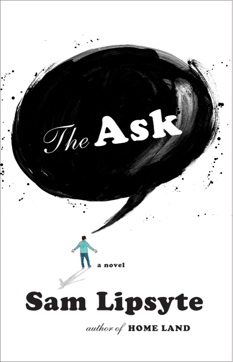
The first-person narrator has just been fired, and rehired, by a university development office, where he had worked as a fund raised. "The Ask" is what they call their pitches to rich potential donors. Narrator gets reassigned to try to touch his old college buddy Purdy, who is incredibly rich. Meanwhile, narrator's marriage is crumbling. Narrator gets tasked by his rich college friend to shush college friend's illegitimate son, now a returned military veteran with two metal legs. The novel is all voice and no narrative. Sort of an American Martin Amis, but more of an obvious one-lining jokester.
All that said, what a voice:
Child care was like everything else. You got what you paid for, and your child paid for what you could not pay for.
You really had to hustle to recruit the right people to prop up your delusions, but the moment somebody broke ranks, or just broke for a protein shake, the whole deal teetered.
We were like the Frank family in their Dutch attic, but with email.
Why was I such a diseased fuck? It had to be society's fault. I loved people, all people, except for the ones with money and free time.
I dozed off worried I had truly unhooked myself from the apparatus of okay.
Never let them see you sweat, countless bastards tell us, just to see us sweat.
Sayuri's family moved back to Japan soon after, but from then on, whenever I inserted my penis in her hard little hand, I always made sure to insert the gray pixelated dot over it, like they did in Japanese porn. Honor is important to every culture.
"Hell, honey," said Claudia. "I murdered your father when you needed him most. I can take a few impotent barbs from my only son."
The man's hands looked ruined, though, rheumatoid, nicked and pinched by gruesome machinery. I'd done many odd jobs in my life, but hardly any heavy lifting. I stared at my own hands, soft, expressive things, gifted, even, like specially bred, lovingly shaved gerbils.
"But don't get me wrong. I'm all for capital punishment. I'm a huge death penalty guy. I like everything about it. And don't tell me how it's more expensive to the taxpayer than life sentences. Because if you ask me, we should pony up a little more. We should feel the cost of our ritual, revel in it. It was probably a drain on the Aztec economy to capture and drug all those people and carve out their living hearts, but are you going to tell me it wasn't worth it? Yes, sir, the death penalty is where it's at. Is there a chance innocent people die? I should fuckin hope so! Innocent people die constantly in this world. Why should things be better for those scumbags in lockdown?"
(on being an artist) "So, like I always say, it all comes down to how much you need to inflict yourself on the world. You're good enough. If you kiss the right ass, you could certainly make a career.
Wednesday, March 16, 2011
Devotion by Howard Norman
 Norman clobbers the reader with his swans metaphor. Not much else happens.
Wednesday, March 09, 2011
Freedom by Jonathan Franzen

It’s thick and richly painted as far as it goes – but the sameness of each character’s “interior-ity” (is that a word?) deadened it for me, on the whole. Everything happened to everyone, and every thought occurred to every character, all the time. In the end, I was repelled (and truth be told, compelled) by how Franzen unspools this vast web of interconnected, richly detailed and remembered neuroses, and lets each character be driven by that, by neuroses and self-obsession. He’s so intelligent and wants to show it all over a wide canvas socially and politically – but I felt barely a ripple of narrative tension. A hundred pages from the end, I felt I could not care less about what was going to happen to the major players. Weirdly, I was most drawn to the characters of Joey and Connie. I hated Walter, though I believed him. Richard I didn’t believe, he seemed another side of Walter. Patty was hard for me to believe — Walter and Richard I could buy as having such verbose and self-scrutinizing inner lives – but not the alleged college jock. Also liked Patty's female college stalker, until she got addicted to heroin and sort of dribbled off into cliche. A way different sort of ménage a trois than To The End of the Land, in any event. Also, of course, energetically envious of the discipline and imagination required to get such a monster down on paper. Even if I seem to critically dislike it.
Friday, February 25, 2011
By Nightfall by Michael Cunningham

Awfully well-written AWFUL new novel (at least it was a quickie) by Michael Cunningham. The main character, Peter, a mildly successful Soho art dealer, has an inner voice that dominates the narration and is the kind of inner voice that one would like to punch in the face. His excruciating self-absorption and self-analysis drain all the life out of the book early. I guess people like Peter exist: I just don't want to know about them.
Enjoyed the observations on NYC and contemporary art, and even on aesthetics generally – but it failed on a flesh and blood level for me. Felt like it wanted to be a much longer book about Rebecca’s family: instead, much of her family got anecdotized (word?).
Peter and his wife Rebecca play host to Rebecca's much younger brother Mizzie (real name Ethan, but called The Mistake by Rebecca's family, since he's about 17 years younger than Rebecca), an aimless drifting twenty-something who has been messed up in drugs and now "wants to do something in the arts." The plot, what there is of it, revolves around Peter's obsession with Mizzie and failed attempt to seduce him.
Cunningham writes gorgeously about New York City, about the contemporary art scene, but fails, it seems to me, to write about Peter's previously heterosexual life with much conviction.
And for me it was just so gay from the get-go, I didn’t buy Peter as formerly straight, even partially straight. He was loathsome, I had not a spark of sympathy. There is an echo of Murdoch – certainly it shares her serious intentions – but it lacks her mordancy, her black-eyed morality, her treacherous plotting, and so some of her humor.
Friday, February 18, 2011
Skippy Dies by Paul Murray
 Little Virgin Suicides by Jeffrey Eugenidies, little Edwin Mullhouse by Steven Millhauser.
Saturday, February 12, 2011
The Passage by Jusin Cronin

Februrary 12, 2010 b.v (from "The Book of Sean")
Have just finished The Passage by Jusin Cronin. No smokes are left in my life, no slims, no virals hang beneath bridges waiting to tear me asunder and drink my blood. I am at peace. Relieved even. My forearm swell with the effort of holding such a heavy book for so many long nights waiting for the lights to come back on. It was not the Book of Dave, oh no, not at all. Futuristic, every post-apocalyptic cliche and device possible.
Subscribe to:
Posts (Atom)
-
 My son and I saw THE HIDDEN FORTRESS at AFI Silver yesterday afternoon, what a masterpiece! The 21-year old Misa Uehara as the Princess was ...
 -
 May he have an accident shaped like an umbrella. [p. 13] Finally reading this after owning it for almost 40 years. Collection of short ...
