Showing posts with label autobiography. Show all posts

Tuesday, September 03, 2024

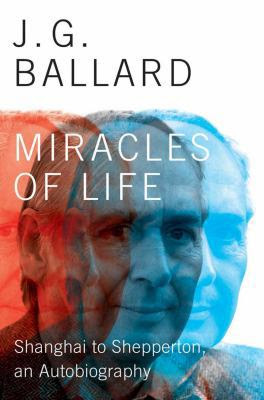
Miracles of Life by J.G. Ballard


A fascinating memoir. Ballard beautifully and deeply engages with his vivid memories of his childhood in Shanghai - first idyllic and strange, then blinkered and strange in a Japanese internment camp during WWII. Reading this with pleasure at the same time I'm struggling to finish his 1975 novel HIGH-RISE (and as I have struggled over the years with his science fiction.)

As a young boy Ballard writes he constructed a large plywood frame screen with a peephole and put it at the center of the table so he would not have to look at his younger sister the whole time.

All in all, a remarkably sane, measured account of a happy life, ending with Ballard announcing he has metastized prostate cancer but is in the care of a good doctor, awaiting his death.

I suspect that it's no longer possible to stir or outrage spectators by aesthetic means alone... A psychological challenge is needed that threatens one of our dearer delusions... a bisected cow forced to endure a second death in order to remind us of the illusions to which we cling about the first.

As every parent knows, infancy and childhood seem to last for ever. Then adolescence arrives and promptly leaves on the next bus, and one is sharing the family home with likeable young adults who are more intelligent, better company and in many ways wiser than oneself. But childhood has gone, and in the silence one stares at the empty whisky bottles in the pantry and wonders if any number of drinks will fill the void. (220)

Tuesday, August 06, 2024

Paul McCartney: Many Years from Now, with Barry Miles


Pretty good, lots on insights, a little annoying in Miles insistence on his own place in the Beatles history, but that's a small point. The chapter on the London cultural and arts scene - when McCartney had bought a house in town, while the other three Beatles had retired to the suburban countryside - is interesting, although McCartney (as always) sound a little glib and fey when discuss art that's not pop and rock songs.

Good source of McCartney's assigning "percentages" of authorship credit to himself and Lennon. Who knows what actually went on? Their whole career was magical and creative and, I'm sure, chaotic. But they wrote 180 songs the likes of which had never been seen before - and won't be seen again.

Thursday, May 16, 2024

Alice Munro RIP

Self-deception seems almost like something that’s a big mistake, that we should learn not to do. But I’m not sure if we can. Everybody's doing their own novel of their own lives. The novel changes -- at first we have a romance, a very satisfying novel that has a rather simple technique, and then we grow out of that and we end up with a very discontinuous, discordant, very contemporary kind of novel. I think that what happens to a lot of us in middle age is that we can't really hang on to our fiction any more.

Memory is the way we keep telling ourselves our stories – and telling other people a somewhat different version of our stories. We can hardly manage our lives without a powerful ongoing narrative. And underneath all these edited, inspired, self-serving stories there is, we suppose, some big bulging awful mysterious entity called THE TRUTH, which our fictional stories are supposed to be poking at and grabbing pieces of. What would be more interesting as a life’s occupation? One of the ways we do this, I think, is by trying to look at what memory does (different tricks at different stages of our lives) and at the way people’s different memories deal with the same (shared) experience. The more disconcerting the differences are, the more the writer in me feels an odd exhilaration.

I’m sad that I haven’t written a lot of things, but I’m incredibly happy that I’ve written as much as I have. Because there was a point when I was younger where there was a very good chance that I wouldn’t write anything – I was just too frightened.

I want to tell a story, in the old-fashioned way – what happens to somebody – but I want that ‘what happens’ to be delivered with quite a bit of interruption, turnarounds, and strangeness. I want the reader to feel something that is astonishing – not the ‘what happens’ but the way everything happens. These long short story fictions do that best, for me.

Friday, April 26, 2024

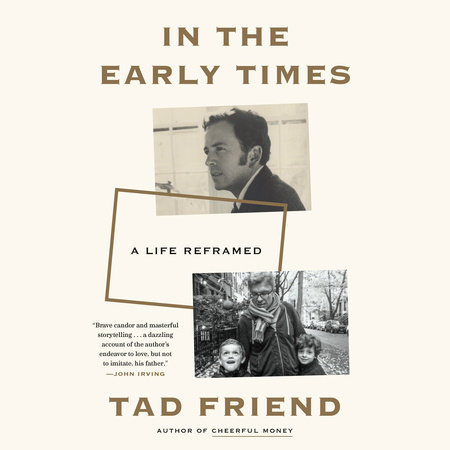
In The Early Times by Tad Friend


Good. Weird. Pretentious.

A brilliantly written and odd book, mostly a memoir and an autobiographic essay by career New Yorker writer Tad friend, but verging at times on crystalline fiction, on sappy self-help relationship book, as furtive apologia by an unreliable narrator who cheats repeatedly on his wife, and finds in his father's life both a justification and a source of blame for this.

Friend's Wasp-y background -- born and raised in New England, his father a distinguished East Asian Studies professor an author and president of Swarthmore, a preppy education and avocations (Tad was a nationally ranked squash player - as was his father) -- this chill and chilly background is at odds with Friend's confessional intention.

If you love a demanding task that requires both discipline and talent...-- you eventually discover an innate boundary: you can apprehend real virtuosity, especially as it's used to best you, but you can never quite incorporate it. You will never be more than almost great...Yet the truly great players sacrifice so much that they stare back at us with equal longing. Or so we console ourselves. [115]

"Oversight" is a Janus word, like "buckle" or "cleave": it means both supervision and neglect [122]

'Life is contemptuous of knowledge; it forces it to sit in the anterooms, to wait outside. Passion, energy, lies: these are what life admires.' - James Salter [128]

'Think well on this, my sweet:
Our bodies need not truly beat 
Upon each other,
But, past their funerary heat.
Will slide together perfectly,
Grain and micrograin
Intimate and without stain,
Closer than ever they were in life.' -Day Friend (Tad's father) [155]

Sunday, January 28, 2024

Who I Am by Pete Townshend


A complex character. Rushed to read this after reading the infamous DEAR BOY autobiography of Keith Moon, who was certainly the heart and blood of The Who. But the astonishing songs, the soul of the band, are almost all Townshend's - and cover such a range from 1963 to 1978 as to almost beggar belief.


All these guys also grew up - and were navigating the end of the 1960s and early 1970s in their early 30s at best, barely matured in one sense, and having seen it all (and more) in another.

And what a band! The Who have been accurately described as a band with four lead soloists - and Moon's idiosyncratic wild and powerful drumming leads the way, along with Townshend's amazing melodic and rhythmic guitar, Entwhistle's foundational (and extremely melodic) bass playing ("Thunderfingers"), and Daltrey's central, powerful roaring voice.

Townshend's voice is strange - defensive, arrogant, slightly delusional (he invented the Internet, power chords, rock opera, among other things) - and his spiritual pursuits are foregrounded while his sexual mishaps are glossed over.

Still, an extraordinary musician and mind - the Beatles had three great songwriters, the Stones had two, but The Who had one, and they still stand in the same ring as those other greats of the pantheon. Dylan is different - he stands apart from any one band. The 1960s singles, The Who Sell Out, Tommy, Who's Next, and Quadrophenia are all five star albums. The Who played and stayed live in a way the Beatles never did.

Wednesday, February 17, 2021

A Promised Land by Barack Obama

Going to keep trying, but find first 100 pages of this boring, like an exquisitely composed speech you slowly realize you've heard before. Even revelations and self-discoveries are posited in rounded prose, without a rise in narrator voice or tone. Don't think I'll learn much from reading it.

Tuesday, June 23, 2020

Confessions of an Irish Rebel by Brendan Behan

Dusty, cheap, falling apart paperback of Behan's 1965 swan song. Stinks of my father's bookcase.

I suppose at heart I am a daylight atheist, for I would not like to die without a priest.

I would not go within an ass's roar of her.

narrator gets in trouble for reading the following to his sick sister, from an olden book, not realizing that the s's looked lik f's ... remarkable for steeling eggs and fucking them ...

Lord Waterford is dead and the devil make his bed,
With an oven for his head, say the Shan Van Vocht.

[snuggling in an armchair with a girl] ... no two people ever slept in each other's arms ... I was as cramped as the crucified

Thursday, August 08, 2019

Thursday, July 25, 2019

Country Girl by Edna O'Briend


She knew everybody, she did everything, she wrote about most of it.

Feminist, risk-taker, rule-breaker.  Barhopping with Brando and Mailer, dropping acid with Laing.

Wednesday, August 01, 2018

Going Away by Clancy Sigal

Stunning book I just heard about.

John Leonard in the New York Times wrote: "Better than any other document I know, Going Away identified, embodied and re‐created the postwar American radical experience. It was as if On the Road had been written by somebody with brains.... (Sigal's) intelligence is always ticking. His ear is superb. His sympathies are promiscuous. His sin is enthusiasm."


Friday, October 07, 2016

Born to Run by Bruce Springsteen

Sailed through this, enjoying it all.   That said, the first 150 pages are best: something about his childhood and adolescence, and the Freehold/Jersey Shore years rings more true than his professional narrative.  Maybe he's more guarded, since he became very famous very quickly, and was plagued by fame (without riches) for the first ten years of his celebrity.

I liked his splendid summary about legendary rock stars and their early deaths - "Aging is scary but fascinating."  His summary?  "The exit in a blaze of glory is bullshit."(p. 214)  His analysis about learning the limitations of his own singing voice and transcending them was also great (p.  494)

His wise decision to seek analysis to help him through depression does not make the most interesting reading:  there is a lot of inner-child speak and other junk.

Later in the book, he assumes his more bloviated gospel-preacher voice, and tends to philosophize generally and use some of his more obvious song metaphors, rather than provide details. Still, for a notoriously private individual who perversely gives so much of himself publically in performance, the book showed me important stuff in his life.

the "Chapter and verse" spotify playlist is great - not as much for the Springsteen songs themselves (who hasn't heard them? and a million times?) as for the 100 or so songs by other artists that were crucial to him.

https://open.spotify.com/user/brucespringsteenmusic/playlist/2DipgwFGoYJghKkr2MK08S

Wednesday, August 20, 2014

A Fighting Chance by Elizabeth Warren


Love her politics, but her prose is less lovely.  Super dull.  Agree with everything she says, but very little color or like-like deal.  She acknowledges her husband for being a "great kisser," which is kind of hot.

Featured Post

Buy my books.

Buy the books on Amazon, and watch videos of some readings.   Please.