Monday, June 03, 2024

In Memoriam by Alice Winn


Stunning WWI novel about two English schoolboys who fall in love, enlist, and then meet again in the trenches at the battle of the Somme.  Terribly sad, quite beautiful - and even ends well! Well, not for most, that is. It's apparently Winn's first novel, but seems a much accomplished and polished and thoughtful work. Her close writing about men on the battlefield is exquisite.

Tuesday, May 28, 2024

Like a Rolling Stone: A Memoir by Jann S. Wenner


Had to put it down not even halfway through. Though the dude knew everybody from the 1960s, his sly and immodest style of claiming to influence almost any important work that took place during his tenure as publisher of Rolling Stone became too annoying for me to take.

Tuesday, May 21, 2024

Dance of the Happy Shades by Alice Munro


Munro's first published book, and a fitting way to kick off my retrospective of her important body of work. She hasn't yet unleashed the "time torquing" technique of her later work, but the stories are wonderfully detailed and the characters deeply engraved.

The story “A Trip to the Coast” ends in a decidedly Flannery O'Connor manner. 

"Walker Brothers Cowboy"
"The Shining Houses"
"Images"
"Thanks for the Ride"
"The Office"
"An Ounce of Cure"
"The Time of Death"
"Day of the Butterfly"
"Boys and Girls"
"Postcard"
"Red Dress—1946"
"Sunday Afternoon"
"A Trip to the Coast"
"The Peace of Utrecht"
"Dance of the Happy Shades"

The Pigman by Paul Zindel


Revisiting this 1968 YA title after fifty years! Still pretty good, pretty sad, little melodramatic, but basically a strong story. The ending particularly bittersweet -- narrator's rumination on how the whole human race are "baboons" waiting around the monkey house for someone to visit.

Thursday, May 16, 2024

Alice Munro RIP

Self-deception seems almost like something that’s a big mistake, that we should learn not to do. But I’m not sure if we can. Everybody's doing their own novel of their own lives. The novel changes -- at first we have a romance, a very satisfying novel that has a rather simple technique, and then we grow out of that and we end up with a very discontinuous, discordant, very contemporary kind of novel. I think that what happens to a lot of us in middle age is that we can't really hang on to our fiction any more.

Memory is the way we keep telling ourselves our stories – and telling other people a somewhat different version of our stories. We can hardly manage our lives without a powerful ongoing narrative. And underneath all these edited, inspired, self-serving stories there is, we suppose, some big bulging awful mysterious entity called THE TRUTH, which our fictional stories are supposed to be poking at and grabbing pieces of. What would be more interesting as a life’s occupation? One of the ways we do this, I think, is by trying to look at what memory does (different tricks at different stages of our lives) and at the way people’s different memories deal with the same (shared) experience. The more disconcerting the differences are, the more the writer in me feels an odd exhilaration.

I’m sad that I haven’t written a lot of things, but I’m incredibly happy that I’ve written as much as I have. Because there was a point when I was younger where there was a very good chance that I wouldn’t write anything – I was just too frightened.

I want to tell a story, in the old-fashioned way – what happens to somebody – but I want that ‘what happens’ to be delivered with quite a bit of interruption, turnarounds, and strangeness. I want the reader to feel something that is astonishing – not the ‘what happens’ but the way everything happens. These long short story fictions do that best, for me.


Wednesday, May 15, 2024

Togdog/Underdog by Suzan-Lori Parks


Re-read this at the beginning of the month, and three days ago saw the powerful production at Round House Theatre in Bethesda. It won the Pulitzer Prize in 2001, for good reason: sort of a True-West-in-the-ghetto drama about two brothers trying to succeed in life and love by switching places, with resonant echoes of a broken family and their inheritances from that.

Monday, May 06, 2024

Four Novels of the 1960s by Philip K. Dick


The Man in the High Castle: Fascinating, weird, psychological alternative history, set in 1962, in the Rockies and in SF, after Germany and Japan won WWII. Dick has quite a beautiful prose style, and several of the characters are obsessed with the I Ching, and the process of casting and reading it are beautifully rendered.

The Three Stigmata of Palmer Eldritch: Even more gripping. A future (2016!) where the solar system has been colonized and conscripts from Earth are drafted to inhabit the rough and ugly planets, surviving by regular hallucinegenic dosing and fantasizing about life inside a barbie-like game construct of Earth. Dick maneuvers the reader into a labyrinthe of real/unreal/surreal settings - his characters don't know if they're dreaming life or living it.

Do Androids Dream of Electric Sheep?: Renowned as the basis for the film BLADE RUNNER, it actually bears only the slightest resemblance. The movie is all neo-noir and stream-punk moody atmospherics, but the novel is more about relationships between the human and non-human, and conversations about the importance of living animals and.

Friday, April 26, 2024

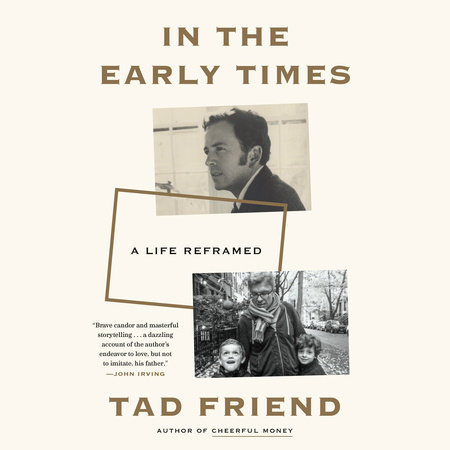
In The Early Times by Tad Friend


Good. Weird. Pretentious.

A brilliantly written and odd book, mostly a memoir and an autobiographic essay by career New Yorker writer Tad friend, but verging at times on crystalline fiction, on sappy self-help relationship book, as furtive apologia by an unreliable narrator who cheats repeatedly on his wife, and finds in his father's life both a justification and a source of blame for this.

Friend's Wasp-y background -- born and raised in New England, his father a distinguished East Asian Studies professor an author and president of Swarthmore, a preppy education and avocations (Tad was a nationally ranked squash player - as was his father) -- this chill and chilly background is at odds with Friend's confessional intention.

If you love a demanding task that requires both discipline and talent...-- you eventually discover an innate boundary: you can apprehend real virtuosity, especially as it's used to best you, but you can never quite incorporate it. You will never be more than almost great...Yet the truly great players sacrifice so much that they stare back at us with equal longing. Or so we console ourselves. [115]

"Oversight" is a Janus word, like "buckle" or "cleave": it means both supervision and neglect [122]

'Life is contemptuous of knowledge; it forces it to sit in the anterooms, to wait outside. Passion, energy, lies: these are what life admires.' - James Salter [128]

'Think well on this, my sweet:
Our bodies need not truly beat 
Upon each other,
But, past their funerary heat.
Will slide together perfectly,
Grain and micrograin
Intimate and without stain,
Closer than ever they were in life.' -Day Friend (Tad's father) [155]

Monday, April 22, 2024

The Whereabouts of Eneas McNulty by Sebastian Barry


Another winner from Barry, this one from 1988, so the earliest of his work that I've read. A Sligoman is caught between nationalist and royal sides in the Irish civil war, given a death sentence, and flees, effectively banished for life. He returns several times, though, unable to completely leave home, which eventually kills him.

In Eneas, Barry has created a memorable, gentle, conflicted character torn on all sides by family, country, spirit, goodness, and evil.

Some words have no tune for themselves. [13]

... it strikes him that any person alive in the world, any person putting a shoulder against a life, no matter how completely failing to do the smallest good thing, is a class of hero. [130]

... the peculiar clock of God, whose divisions seem both unending and brief in the same span... [130]

He passes a number of bottles with thick blue glass and the faces of people he knows etched in them... whole "dying" passage at end of novel, [307-308]

Tuesday, April 16, 2024

Mayflies by Andrew O'Hagan


Good, pungent book. The story of a friendship between two Scottish men broken into two parts: Summer, 1986 and Autumn, 2017. The first half is a trip to Manchester for a concert, and is rip-roaring and drunken, loaded with 18 year old full of themselves and life and bristling with arrogant comic knowledge of a world they barely. The second half, thirty years later, is sobering, to see the least.

Almost all references are insular to UK 1980s pop, American mid-century films, and English literature. Didn't know half of them, but they still gave me a kick.

But found it an abrupt book, something missing from the center, and what happened in the intervening years. Still, O'Hagan a gifted stylist and dialogue-ist. Will seek out more of his work.

They say you know nothing at eighteen. But there are things you know at eighteen that you will never know again. [121]


"'The past isn't really the past, Tully said. 'It's just music, books, and films.'" [p. 244]

Thursday, April 11, 2024

Absolution by Alice McDermott


Liked this, although there's a cautiousness and a certain smugness to (both) the narrator's voices that I dislike. The first half of the book feels like it's heading toward a more dramatic ending that I got, and the switching of narrators between the older woman and the younger woman does not yield significant unveilings of meaning or narrative.

Monday, April 01, 2024

Deliver Me from Nowhere: The Making of Bruce Springsteen's Nebraska by Warren Zanes


Great book! That rare thing, penetrating writing about music.

Cat's Cradle by Kurt Vonnegut


Must have read this before but don't really remember it. It's interesting but seems to be an early (1963) experiment in Vonnegut's more mature and radical books Slaughterhouse-Five and Breakfast of Champions.


The fantastical human-based religion of Bokonism, the short chapters that always end with a flair (if not much narrative oomph), the sci-fi flirtation of the doomsday weapon ice-nine, are all elements to be perfected later.

Wednesday, March 20, 2024

Here, There and Everywhere: My Life Recording the Music of the Beatles by Geoff Emerick


Good but not great. It was a different time - and certainly, just the placement of the microphones and crude primitive physical sound manipulations were enormously important in the 1960s in pop music studios. Emerick is a bit gushing (but it's the Beatles, so who wouldn't be?) and he has a way (as does anyone outside the Beatles who is writing about them) of desperately trying to take credit for something that was most obviously a result of the group's own creative effort and genius.

His recounting of the recording of Revolver -- and especially Abbey Road -- are the highlights.

Some of his anecdotes - John and Yoko dragging a bed into the studio during the recording of Abbey Road, Lennon high on acid being rescued by the other three from the roof of the studio, George Martin's chilliness - are great. But barely registers against Lewisohn's stunning biography.

Tuesday, March 05, 2024

Time for the Stars by Robert A. Heinlein


Pairs of twins on earth are trained as telepathic modes of communication: one will embark on space travel and the other will stay earthside, and together they will transmit news and updates instantaneously across a trillion miles. Time, however, will pass more slowly for the twin travelling through space at a speed just below the speed of light, making for uneasy relationships between twins who started out the same age but end up vastly separated by time AND space. Interesting although not much happens.

Featured Post

Buy my books.

Buy the books on Amazon, and watch videos of some readings.   Please.