Tuesday, March 29, 2011

Mr. Peanut by Adam Ross


Very interesting, at times sublime, novel. Three novels in one, at least. The first, framing story is about the down-turn of the marriage of a very successful video game designer and a counselor for disturbed children, a woman who has lost over 150 pounds finally after years of dieting. Her husband, though, over the 13 years of their marriage, has found himself fantasizing often about her death. And that's how the novel opens, with the husband accused of killing her by forcing two fistfuls of peanuts down her throat, which she is highly allergic to, and which he knows will kill her. The husband is also writing a novel, which may or may not be the book we are reading. He's also been in touch with a private eye/hired killer named Mobius, who may or may not have decided to murder the wife on his own

Enter novels number two and three, about the two detectives who question the husband. The first detective is suffering marital woes of his own: his wife has refused to leave her bedroom for five months. The second detective is none other than Sam Shepard, the midwest doctor accused of murdering his wife, who was exonerated and released from prison after serving ten years, a case widely believed to be the basis of the TV series The Fugitive.

The lengthy novella about Sam Shepard's marriage and affairs might be the best thing about the book, although all three stories have their power.

It's a bit of a puzzle piece, sorting out what is real, what is imagined, what is the first husband's imagination, what's his novel, and what's the real narrative we're reading.

In the end, it's a dark, compulsive, often beautiful examination of marriage almost exclusively through several husbands' eyes. Men don't come out smelling too nice by the end. Women aren't much better.

Friday, March 25, 2011

Solar by Ian McEwan

A nice corrective to Franzen's Freedom, in the category of "climate-change fiction." McEwan, skillful as always, has no trouble at all navigating the worlds of post-quantum physics, 21st climatology, dance apparel shops in contemporary London, Arctic Circle snowmobile tours. His anti-hero, corpulent, adulterous, selfish physicist Michael Beard, is a Nobel-prize-winning comic figure who steals ideas, cheats on dozens of women (including five wives), rigs murder scenes and nearly freezes his penis off on said snowmobile tour.

Recommended!

Tuesday, March 22, 2011

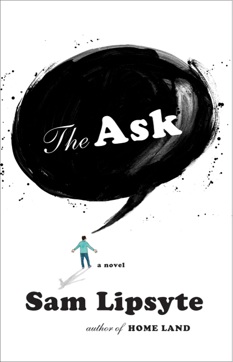
The Ask by Sam Lipsyte


The first-person narrator has just been fired, and rehired, by a university development office, where he had worked as a fund raised. "The Ask" is what they call their pitches to rich potential donors. Narrator gets reassigned to try to touch his old college buddy Purdy, who is incredibly rich. Meanwhile, narrator's marriage is crumbling. Narrator gets tasked by his rich college friend to shush college friend's illegitimate son, now a returned military veteran with two metal legs. The novel is all voice and no narrative. Sort of an American Martin Amis, but more of an obvious one-lining jokester.

All that said, what a voice:

Child care was like everything else. You got what you paid for, and your child paid for what you could not pay for.

You really had to hustle to recruit the right people to prop up your delusions, but the moment somebody broke ranks, or just broke for a protein shake, the whole deal teetered.

We were like the Frank family in their Dutch attic, but with email.

Why was I such a diseased fuck? It had to be society's fault. I loved people, all people, except for the ones with money and free time.

I dozed off worried I had truly unhooked myself from the apparatus of okay.

Never let them see you sweat, countless bastards tell us, just to see us sweat.

Sayuri's family moved back to Japan soon after, but from then on, whenever I inserted my penis in her hard little hand, I always made sure to insert the gray pixelated dot over it, like they did in Japanese porn. Honor is important to every culture.

"Hell, honey," said Claudia. "I murdered your father when you needed him most. I can take a few impotent barbs from my only son."

The man's hands looked ruined, though, rheumatoid, nicked and pinched by gruesome machinery. I'd done many odd jobs in my life, but hardly any heavy lifting. I stared at my own hands, soft, expressive things, gifted, even, like specially bred, lovingly shaved gerbils.

"But don't get me wrong. I'm all for capital punishment. I'm a huge death penalty guy. I like everything about it. And don't tell me how it's more expensive to the taxpayer than life sentences. Because if you ask me, we should pony up a little more. We should feel the cost of our ritual, revel in it. It was probably a drain on the Aztec economy to capture and drug all those people and carve out their living hearts, but are you going to tell me it wasn't worth it? Yes, sir, the death penalty is where it's at. Is there a chance innocent people die? I should fuckin hope so! Innocent people die constantly in this world. Why should things be better for those scumbags in lockdown?"

(on being an artist) "So, like I always say, it all comes down to how much you need to inflict yourself on the world. You're good enough. If you kiss the right ass, you could certainly make a career.

Wednesday, March 16, 2011

Devotion by Howard Norman

Norman clobbers the reader with his swans metaphor. Not much else happens.

Wednesday, March 09, 2011

Freedom by Jonathan Franzen


It’s thick and richly painted as far as it goes – but the sameness of each character’s “interior-ity” (is that a word?) deadened it for me, on the whole. Everything happened to everyone, and every thought occurred to every character, all the time. In the end, I was repelled (and truth be told, compelled) by how Franzen unspools this vast web of interconnected, richly detailed and remembered neuroses, and lets each character be driven by that, by neuroses and self-obsession. He’s so intelligent and wants to show it all over a wide canvas socially and politically – but I felt barely a ripple of narrative tension. A hundred pages from the end, I felt I could not care less about what was going to happen to the major players. Weirdly, I was most drawn to the characters of Joey and Connie. I hated Walter, though I believed him. Richard I didn’t believe, he seemed another side of Walter. Patty was hard for me to believe — Walter and Richard I could buy as having such verbose and self-scrutinizing inner lives – but not the alleged college jock. Also liked Patty's female college stalker, until she got addicted to heroin and sort of dribbled off into cliche. A way different sort of ménage a trois than To The End of the Land, in any event. Also, of course, energetically envious of the discipline and imagination required to get such a monster down on paper. Even if I seem to critically dislike it.

Friday, February 25, 2011

By Nightfall by Michael Cunningham


Awfully well-written AWFUL new novel (at least it was a quickie) by Michael Cunningham. The main character, Peter, a mildly successful Soho art dealer, has an inner voice that dominates the narration and is the kind of inner voice that one would like to punch in the face. His excruciating self-absorption and self-analysis drain all the life out of the book early. I guess people like Peter exist: I just don't want to know about them.

Enjoyed the observations on NYC and contemporary art, and even on aesthetics generally – but it failed on a flesh and blood level for me. Felt like it wanted to be a much longer book about Rebecca’s family: instead, much of her family got anecdotized (word?).

Peter and his wife Rebecca play host to Rebecca's much younger brother Mizzie (real name Ethan, but called The Mistake by Rebecca's family, since he's about 17 years younger than Rebecca), an aimless drifting twenty-something who has been messed up in drugs and now "wants to do something in the arts." The plot, what there is of it, revolves around Peter's obsession with Mizzie and failed attempt to seduce him.

Cunningham writes gorgeously about New York City, about the contemporary art scene, but fails, it seems to me, to write about Peter's previously heterosexual life with much conviction.
And for me it was just so gay from the get-go, I didn’t buy Peter as formerly straight, even partially straight. He was loathsome, I had not a spark of sympathy. There is an echo of Murdoch – certainly it shares her serious intentions – but it lacks her mordancy, her black-eyed morality, her treacherous plotting, and so some of her humor.

Friday, February 18, 2011

Skippy Dies by Paul Murray

Little Virgin Suicides by Jeffrey Eugenidies, little Edwin Mullhouse by Steven Millhauser.

Saturday, February 12, 2011

The Passage by Jusin Cronin


Februrary 12, 2010 b.v (from "The Book of Sean")
Have just finished The Passage by Jusin Cronin. No smokes are left in my life, no slims, no virals hang beneath bridges waiting to tear me asunder and drink my blood. I am at peace. Relieved even. My forearm swell with the effort of holding such a heavy book for so many long nights waiting for the lights to come back on. It was not the Book of Dave, oh no, not at all. Futuristic, every post-apocalyptic cliche and device possible.

Tuesday, January 18, 2011

Tinkers by Paul Harding


Mixed up narrative, the son dying present tense, crosscut with the father's tinker trip though the woods a half-century earlier. Long, blowing, circularly-breathed sentences, a la William Faulkner, via Cormac McCarthy.

Sunday, January 16, 2011

Maggot poems by Paul Muldoon

from the "Let's Hope He's Talking About Himself" Department...

One of the terrible facts about writing poetry is that actually one almost certainly disimproves as one continues…Most people who write poetry get worse. There are various other callings, one thinks, for example, of math. Most people involved with math, from what I understand, peak if they peak at all, earlier in their careers. And poetry, for whatever reason, it’s hard to write decent poetry in the first place and it’s very hard to continue to write it.

Here's an old one by Muldoon, which I must admit I like much better than anything in MAGGOT. It's long, but if that's its worst flaw I can forgive him.


The Old Country by Paul Muldoon


I
Where every town was a tidy town
and every garden a hanging garden.
A half could be had for half a crown.
Every major artery would harden

since every meal was a square meal.
Every clothesline showed a line of undies
yet no house was in dishabille.
Every Sunday took a month of Sundays

till everyone got it off by heart
every start was a bad start
since all conclusions were foregone.

Every wood had its twist of woodbine.
Every cliff its herd of fatalistic swine.
Every runnel was a Rubicon.

II
Every runnel was a Rubicon
and every annual a hardy annual
applying itself like linen to a lawn.
Every glove compartment held a manual

and a map of the roads, major and minor.
Every major road had major road works.
Every wishy-washy water diviner
had stood like a bulwark

against something worth standing against.
The smell of incense left us incensed
at the firing of the fort.

Every heron was a presager
of some disaster after which, we’d wager,
every resort was a last resort.
III

Every resort was a last resort
with a harbor that harbored an old grudge.
Every sale was a selling short.
There were those who simply wouldn’t budge

from the Dandy to the Rover.
That shouting was the shouting
but for which it was all over –
the weekend, I mean, we set off on an outing

with the weekday train timetable.
Every tower was a tower of Babel
that graced each corner of a bawn

where every lookout was a poor lookout.
Every rill had its unflashy trout.
Every runnel was a Rubicon.

IV

Every runnel was a Rubicon
where every ditch was a last ditch.
Every man was “a grand wee mon”
whose every pitch was another sales pitch

now every boat was a burned boat.
Every cap was a cap in hand.
Every coat a trailed coat.
Every band was a gallant band

across the broken bridge
and broken ridge after broken ridge
where you couldn’t beat a stick with a big stick.
.
Every straight road was a straight up speed trap.
Every decision was a snap.
Every cut was a cut to the quick.
V

Every cut was a cut to the quick
when the weasel’s twist met the weasel’s tooth
and Christ was somewhat impolitic
in branding as “weasels fighting in a hole”, forsooth,

the petrol-smugglers back on the old sod
when a vendor of red diesel
for whom every rod was a green rod
reminded one and all that the weasel

was nowhere to be found in that same quarter.
No mere mortar could withstand a ten-inch mortar.
Every hope was a forlorn hope.

So it was that the defenders
were taken in by their own blood-splendour.
Every slope was a slippery slope.

VI

Every slope was a slippery slope
where every shave was a very close shave
and money was money for old rope
where every grave was a watery grave

now every boat was, again, a burned boat.
Every dime-a-dozen rat a dime-a-dozen drowned rat
except for the whitrack, or stoat,
which the very Norsemen had down pat

as a weasel-word
though we know their speech was rather slurred.
Every time was time in the nick

just as every nick was a nick in time.
Every unsheathed sword was somehow sheathed in rime.
Every cut was a cut to the quick.
VII

Every cut was a cut to the quick
what with every feather a feather to ruffle.
Every whitrack was a whitterick.
Everyone was in a right kerfuffle

when from his hob some hobbledehoy
would venture the whitterick was a curlew.
Every wall was a wall of Troy
and every hunt a hunt in the purlieu

of a demesne so out of bounds
every hound might have been a hell-hound.
At every lane-end stood a milk-churn

whose every dent was a sign of indenture
to some pig-wormer or cattle-drencher.
Every point was a point of no return.


VIII

Every point was a point of no return
for those who had signed the Covenant in blood.
Every fern was a maidenhair fern
that gave every eye an eyeful of mud

ere it was plucked out and cast into the flame.
Every rowan was a mountain-ash.
Every swath-swathed mower made of his graft a game
and the hay-sash

went to the kemper best fit to kemp.
Every secretary was a temp
who could shift shape

like the river goddesses Banna and Boann.
Every two-a-penny maze was, at its heart, Minoan.
Every escape was a narrow escape.
IX

Every escape was a narrow escape
where every stroke was a broad stroke
of an ax on a pig-nape.
Every pig was a pig in a poke

though it scooted once through the Diamond
so unfalt… so unfalteringly.
The threshold of pain was outlimened
by the bar raised at high tea

now every scone was a drop scone.
Every ass had an ass’s jawbone
that might itself drop from grin to girn.

Every malt was a single malt.
Every pillar was a pillar of salt.
Every point was a point of no return.

X

Every point was a point of no return
where to make a mark was to overstep the mark.
Every brae had its own braw burn.
Every meadow had its meadowlark

that stood in for the laverock.
Those Norse had tried fjord after fjord
to find a tight wee place to dock.
When he made a scourge of small whin-cords,

Christ drove out the money-lenders
and all the other bitter-enders
when the thing to have done was take up the slack.

Whin was to furze as furze was to gorse.
Every hobbledehoy had his hobbledyhobbyhorse.
Every track was an inside track.
XI


Every track was an inside track
where every horse had the horse-sense
to know it was only a glorified hack.
Every graineen of gratitude was immense

and every platitude a familiar platitude.
Every kemple of hay was a kemple tossed in the air
by a haymaker in a hay-feud.
Every chair at the barn-dance a musical chair

given how every paltry poltroon
and his paltry dog could carry a tune
yet no one would carry the can

any more than Samson would carry the temple.
Every spinal column was a collapsing stemple.
Every flash was a flash in the pan.

XII


Every flash was a flash in the pan
and every border a herbaceous border
unless it happened to be an
herbaceous border as observed by the Recorder

or recorded by the Observer.
Every widdie stemmed from a willow-bole.
Every fervor was a religious fervor
by which we’d fly the godforsaken hole

into which we’d been flung by it.
Every pit was a bottomless pit
out of which every pig needed a piggyback.

Every cow had subsided in its subsidy.
Biddy winked at Paddy and Paddy winked at Biddy.
Every track was an inside track.

XIII


Every track was an inside track
and every job an inside job.
Every whitterick had been a whitrack
until, from his hobbledehob,

that hobbledehobbledehoy
had insisted the whitterick was a curlew.
But every boy was still “one of the boys”
and every girl “ye girl ye”

for whom every dance was a last dance
and every chance a last chance
and every let-down a terrible let-down

from the days when every list was a laundry list
in that old country where, we reminisced,
every town was a tidy town.

"Good-looking is the new well-read."

Saturday, January 01, 2011

To The end of the Land by David Grossman


Working up a review (download the .pdf!) of this novel for Tikkun, but need to mark it in time here. So far so good, two-thirds through it, a bit of a slog and not as earth-shattering as his 1989 work, See Under: Love, but Grossman builds and builds and builds in his novels, so I'm very interested in what happens at the end. Something better happen, that's for sure. Just sayin'.

Certainly reading Keith Richards' Life at the same time isn't helping me finish this. Imagine two more dissimilar books.

Life by Keith Richards


Don't know if he actually wrote a word of it, but the stories ring true, and the voice is the half-annoying, ribald, arrogant Keith Richards voice. A lot of the background social history for the fifties and sixties doesn't sound like him, and there's a lot of "it was my idea first, then Mick's" language around individual song compositions.

Here's a typical infuriating passage about his friendship with American saxophonist Bobby Keys:

'You have to ask Bobby Keys how big Texas is. It took me thirty years to convince him that Texas was actually just a huge landgrab by Sam Houston and Stephen Austin. "No fucking way. How dare you!" He's red in the face. So I laid a few books on him about what actually happened between Texas and Mexico, and six months later he says, "Your case seems to have some substance." I know the feeling, Bob. I used to believe that Scotland Yard was lily-white.'

Just not really believable, any of it. And the voice is ridiculous. Or this passage, allegedly from a notebook of song ideas and sketches that Richards kept during the mid-1960s:

JUKE JOINT... ALABAMA? GEORGIA?
Finally I'm in my element! An incredible band is wailing on a stage decorated with phosphorescent paint, the dance floor is moving as one, so does the sweat and the ribs cooking out back. The only thing that makes me stand out is that I'm white! Wonderfully, no one notices this aberration. I am accepted, I'm made to feel so warm. I am in heaven!

Still, a delish thing to read, impossible to put down.

Titus Andronicus, "The Monitor"

Monday, December 13, 2010

Versailles by Kathryn Davis


Liberty is a bitch who must be bedded on a mattress of corpses.

A wondous slender book about Marie Antoinette's career as the Queen of France and the scourge of the French Revolution.

Davis style -- of a compressed descriptive narrative in Marie Antoinette's voice, an omnisciene "brochure voice" describing the structural achievement of the palace, and the natural spectacle of the gardens, as well as little dramatic "playlets" featuring other characters from the period before and during the Revolution -- has an awesome cumulative effect, that took me by emotional surprise at the end of the novel. I cared for Marie Antoinette, cared for her one little voice piping up from the crush of a humanity in revolt.

Tuesday, December 07, 2010

Cock and Bull by Will Self


Carol had a good head for alcohol - in fact, she had a spy's head for alcohol; for as she drank, her washed blue eyes grew flatter and beadier, giving an accurate, if tarnished reflection of some pebbledashed saturnalia. That's what one felt, watching her: that as she drank, she was somehow accumulating evidence against those who got drunk.

A little devil sat on Alan's left shoulder, a little angel on his right. On the right-hand shoulder of the little devil sat a littler angel; and on the left-hand shoulder a littler devil. It was the same for the first angel, and so on, and so on. This was the reductio ad infinitum of Alan's moral sense: a great Renaissance canvas depicting diminishing tiers of cherubim and seraphim, imps, satyrs and familiars. All towering up into an impossible void.

In this world where all are mad and none are bad, we all know that the finger points backwards.

Wednesday, December 01, 2010

Lauren Bacall singing "Sob Sister" in The Big Sleep

Click here to watch the clip on YouTube.

What a film! Wonderfully sharp writing (Faulkner kicked in on the screenplay), Bogart and Bacall hitting all the high notes. Interesting commentary with dvd on how the film was held a year and a half for the war to end so the studio could rush all its war pictures out before it ended. Also, some of Bacall's scenes were reshot, and extra ones with her added, on the advice of her agent, who was trying to help her recover from her bad reviews in The Confidential Agent, her previous film. And they took her veil off her, which is aesthetically pleasing!

Monday, November 22, 2010

See Under: Love by David Grossman

A nuanced, high-octane-language experiment in memory, imagination, language and longing, wise and cruel and intelligent and relentless. Long and grueling, too, imitative of the ordeal of the Holocaust experience itself, which at least ended temporally, and the eternal struggle for Jews and others to try to understand the unimaginable.

The first section, Momik, is from a young boy's point of view, who will later go on in life to try to write about the Holocaust. Living in a small town in Israel, with his parents, addled Holocaust survivors whose fears are endless, Momik creates a collection of animals in his basement in order to lure into the open "The Nazi Beast" which his parents and family constantly and ominously refer to, and which he thinks is a monstrous animal. At one point he leads a collection of the town most pitiful and lost souls, also Holocaust survivors, down into the cellar to use them to bait the Nazi Beast:

... Show it, show it, go on, be Jews and show it, and he crouched down with his hands on his knees as if he were coaching the players on the soccer field and inwardly shouted, Now, now, go on, be wizards and prophets and witches and let's give it one more battle, one last fight, be so Jewish it won't know what to do with itself, and even if the Beast was never here before, now it's got to come out...

The second section, Bruno, is from an adult Momik's viewpoint as he researches the writings of Bruno Schulz, a Jewish writer shot by an SS man during WWII.

The sea smiles. It slides a wave Bruno's way, an experienced croupier dealing out a lucky card to a regular customer.


Now I write with a steady pen: Bruno Schulz. Ingenious architect of a singular linguistic experience, the magic of which lies in fertility, a plethora almost rotting with verbal juices. Bruno who knows how to say everything in ten different ways, each as accurate as the compass needle. A Don Juan of language, conquering with a mad, almost immoral passion, audacious explorer of linguistic geography ... Could it be that you, Bruno, reached the limits of this world, and ran around like a madman on the beach when you couldn't find a suitable verbal vessel to sail you into the misty horizon?

The third section, Wasserman, concerns Momik's grandfather and his odd relationship with the commandant of his concentration camp, Neigel. Wasserman suffers a curious ironic condition in the camp: he cannot be killed. And when Neigel learns that Wasserman is author of a series of childhood stories, The Children of the Heart, which Neigel loved, he makes Wasserman live in his attic and begin a new series of adventures for The Children, picking up fifty years later in their lives. He calls Wasserman Scheherezade, and gives him the obverse fate: after each nightly story Wasserman tells him, Neigel will attempt to murder Wasserman again, which is all Wasserman wants, having seen his wife perish in the camp, and his daughter shot to death by Neigel right after they got off the transport train.

The fourth section, The Complete Encyclopedia of Kazik's Life, is an alphabetical concordance of Hebrew terms, in which is related the autobiography of Kazik, a mystical child engendered by the reunited Children of the Heart. Kazik is born, lives and dies within a single day, a la Max Tivoli, the Fitzgerald story, and the Curious Case of Benjamin Button.

In his essay on literature, "Books That Have Read Me," Grossman remembers reading books as a child in a poetic and archaic Hebrew that was very far from the everyday language he knew, and it was a pleasure for him, the unknown words, the gaps, "inferring one thing from another." He transfers that sensation to us in this novel, which is laced with Hebrew words (some defined in a glossary at the end of the book, but many more not).

Monday, November 15, 2010

Room by Emma Donoghue


Shortlisted for the 2010 Booker Prize, Room has a glorious initial premise: it's a first-person narration by a five-year-old boy (Jack) who's held hostage in a tiny backyard shed by a brutal man (Old Nick) who kidnapped Jack's mother (Ma) when she was nineteen and raped her repeatedly. Jack has spent his entire life in the shed, with only a skylight window. And the novel opens on Jack's fifth birthday, where his mother has decided Jack's finally just barely old enough to help her in a desperate attempt to escape.

Whew. Writes itself, right? Jack's voice is marvelous throughout. It reminded me of Roddy Doyle's Paddy Clarke Ha ha. And for some reason a little of Flowers for Algernon.

The book is in two parts: Inside and Outside. Though the voice of Jack, and the character of his Ma are consistently strong and engaging, the plot suffers once they get Out. We miss Old Nick's malevolent presence just off screen. Of course, Jack must learn the entire world, which is what makes the second half interesting. He knew of only two other people in existence. He had never been outside, seen sky, walk up a step.

Saturday, November 06, 2010

A Visit from the Goon Squad by Jennifer Egan

Not really about music, although ostensibly about a handful of people who first meet in 1980 during the rise of the punk (well, post-punk, really) era. First Egan novel I've read, and I'm impressed. A book about survivorship and bad choices and persistence and emotional pain, among other things. Egan effortlessly describes the lower East Side of Manhattan, Naples, the African veldt, suburban New York suburbs. It reminded me (in a way) of David Mitchell's Cloud Atlas, in that the chapters move radically in voice and time and emphasis one to the next, in the manner of wonderful, sadistic meal, where you are left longing for the last taste in your mouth, even as a new and even better taste replaces it. I suffered from chapter-nostalgia constantly.

Featured Post

Buy my books.

Buy the books on Amazon, and watch videos of some readings.   Please.